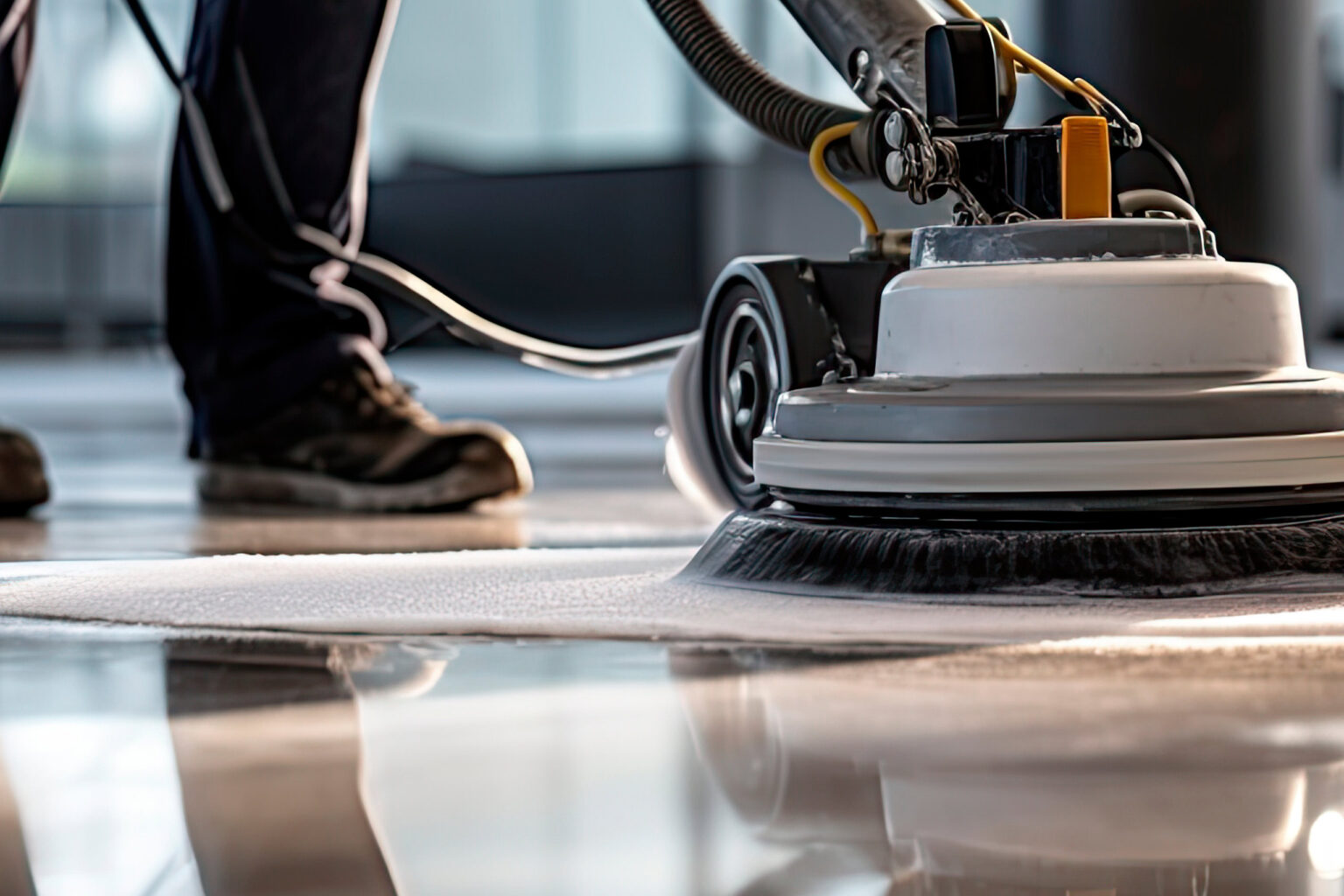
Janitorial staff vs floor cleaning specialists is not a question of which one matters more. It is about knowing what each team is trained to do and when your commercial floors need more than daily upkeep.
Most commercial facilities need both. Janitorial services keep the space clean day to day, while floor cleaning specialists handle deep cleaning, restoration, floor finish care, and long-term protection. When facility managers understand the difference, they can make better decisions for safety, appearance, and cost control.
Why This Difference Matters in a Commercial Building
In a busy commercial building, floors take constant abuse from shoes, carts, spills, moisture, soil, and cleaning products. Daily cleaning helps, but it does not always remove embedded dirt, worn finish, stained grout, or traffic-lane buildup.
That is where the difference between janitorial and cleaning services becomes important. Regular janitorial cleaning services support general cleanliness. Specialized floor care protects the flooring system itself.
Routine Cleaning Tasks Are Not the Same as Floor Care
Janitorial staff usually handle everyday cleaning tasks that keep commercial spaces presentable. These routine cleaning tasks may include:
- Emptying trash bins
- Restocking supplies like toilet paper and paper towels
- Wiping counters, desks, and touchpoints
- Vacuuming open carpeted areas
- Damp mopping hard floors
- Basic restroom cleaning
- Light dusting
- Spot cleaning visible spills
These daily janitorial tasks are important. They help keep the space clean and support a healthy environment for employees, visitors, and customers. But surface level cleaning does not always solve deeper floor problems.
Floor care is different. It looks at the condition of the flooring material, finish, grout lines, carpet fibers, traffic patterns, and cleaning residue. A floor can look “clean enough” after nightly cleaning but still hold soil, bacteria, moisture, and chemical buildup below the surface.
How Floors Affect Safety, Appearance, and Long-Term Costs
Floors influence how people judge a facility. A dull lobby, stained carpet, slippery hallway, or dirty grout line can make a professional business look neglected.
The bigger issue is long-term damage. Without regular maintenance, floors may wear out faster, lose finish protection, or become harder to clean. For commercial properties, that can lead to higher repair costs, replacement costs, and liability concerns.
Floor condition affects:
| Facility concern | How poor floor care creates problems |
| Safety | Slippery residue, worn walkways, loose soil, and moisture can increase risk |
| Appearance | Dull finish, stains, scuffs, and embedded dirt make spaces look older |
| Cost savings | Preventive care can reduce premature replacement and heavy restoration needs |
| Indoor cleanliness | Carpets, grout, and hard-to-reach areas can hold soil and contaminants |
| Brand image | Clean floors support a professional appearance in client-facing areas |
Once you understand why floors need more than everyday upkeep, the next step is knowing what janitorial staff usually handle in commercial spaces.
What Janitorial Staff Usually Handle in Commercial Spaces
Janitorial staff play a crucial role in day to day maintenance. Without them, commercial facilities would quickly become messy, uncomfortable, and harder to manage. Their work supports regular cleaning, sanitation, and basic order across the facility.
The key is understanding their scope. Most janitorial services are designed for frequent, smaller cleaning tasks, not specialized floor restoration.
Daily Surface Cleaning, Trash Removal, and Basic Upkeep
A janitorial company or in house staff often works during business hours, after hours, or overnight depending on the facility. Their job is to keep the building usable and presentable.
Common janitorial tasks include:
- Trash removal and replacing liners
- Emptying trash bins in offices, restrooms, and shared areas
- Vacuuming carpeted walkways
- Mopping spills and visible soil
- Cleaning restrooms and breakrooms
- Restocking supplies
- Dusting surfaces
- Window cleaning or light glass cleaning
- General tidying of shared spaces
Some commercial cleaning services may also include window washing, upholstery cleaning, post construction cleanup, or other professional cleaning services. The exact scope depends on the cleaning company and contract.
For many retail stores, offices, schools, medical buildings, and government facilities, this level of support is necessary every day.
Where General Cleaning Services Can Fall Short
General cleaning services are not usually built around advanced floor care. A janitorial team may clean the visible surface, but they may not have the time, specialized equipment, chemistry knowledge, or trained technicians needed for deeper floor issues.
For example, a mop may remove surface dirt from a VCT floor, but it will not restore worn floor finish. Vacuuming carpet may remove loose debris, but it will not replace deep carpet cleaning. A basic cleaner may make tile look better for the moment, but it may not remove detergent residue or grout buildup.
Common limits of janitorial cleaning include:
- Limited time per area
- Basic equipment instead of commercial floor machines
- General-purpose cleaning solutions
- Limited training for specific floor materials
- Focus on daily appearance rather than long-term floor protection
- No deep restoration process for finish, grout, carpet fiber, or rubber surfaces
Unlike janitorial cleaning, specialized cleaning is built around the flooring material and the problem being solved. That leads into what floor cleaning specialists do differently.
What Floor Cleaning Specialists Do Differently
Floor cleaning specialists focus on the floors as a long-term asset. Their job is not only to make floors look cleaner today, but also to help them last longer, perform better, and support clean and healthy spaces.
A floor-focused cleaning company looks at the floor type, soil level, finish condition, foot traffic, moisture exposure, and maintenance history before choosing the right process.
Deep Cleaning for Carpet, VCT, LVT, Tile, Rubber, and Wood Floors
Deep cleaning goes beyond daily mopping or vacuuming. It removes soil and buildup that regular cleaning cannot reach.
Different floors need different methods:
| Floor type | What specialists usually address |
| Carpet | Embedded dirt, traffic lanes, stains, odors, and deep carpet cleaning needs |
| VCT and LVT | Worn finish, dullness, scuffs, stripping, waxing, and maintenance cycles |
| Tile and stone | Grout buildup, detergent residue, stains, and surface restoration |
| Rubber floors | Soil buildup, sticky residue, gym traffic, scuffs, and finish compatibility |
| Wood floors | Finish-safe cleaning, moisture control, and surface protection |
This is why Scher Flooring Services offers specialized commercial floor cleaning instead of treating every floor the same. A healthcare hallway, restaurant dining area, school corridor, and hotel lobby each have different traffic levels, cleaning needs, and safety concerns.
For vinyl floors, Scher’s VCT/LVT cleaning, stripping, and waxing services are designed around floor finish protection and restoration. For tile and stone, Scher’s commercial tile floor cleaning services focus on cleaning, restoring, and protecting hard surfaces.
Equipment, Products, and Process Knowledge Matter
Specialized equipment is one of the biggest key differences between janitorial staff and floor cleaning specialists. A mop, vacuum, and bucket can handle routine tasks, but they cannot solve every floor care problem.
Specialists may use:
- Auto-scrubbers
- Rotary machines
- Wet vac systems
- Extraction equipment
- Floor buffers
- Commercial carpet cleaning equipment
- Specialty pads and brushes
- Finish applicators
- Floor-safe cleaning solutions
The equipment matters, but process knowledge matters just as much. Using the wrong pad, chemical, dilution, or method can damage floors. Too much moisture can affect certain materials. Strong cleaners can dull finish. Residue can make floors slippery or attract more soil.
Trained technicians understand how to match the process to the floor.
Why Floor Finish, Moisture, and Traffic Patterns Need Expert Care
A commercial floor does not wear evenly. Entrances, hallways, elevators, restrooms, cafeteria areas, and lobby paths often show damage first. These high-traffic zones collect more soil and lose finish faster.
Moisture also matters. Entryways may bring in rain, ice melt, salt, mud, and grit. Restaurants deal with grease and spills. Healthcare facilities may need careful cleaning around safety and hygiene standards. Fitness centers may have sweat, rubber flooring, and frequent disinfecting needs.
A specialist looks at these conditions and builds a tailored plan. That is why Scher offers custom floor maintenance plans for commercial carpet and floor cleaning, restoration, and maintenance.
Now that the specialist role is clear, it helps to compare commercial cleaning services and specialized floor cleaning solutions side by side.
Commercial Cleaning Services vs Specialized Floor Cleaning Solutions
Commercial cleaning services and specialized floor cleaning solutions often work best together. One handles daily building cleanliness. The other protects flooring performance and appearance over time.
This is not an either-or decision for most commercial facilities. It is about using the right service providers for the right cleaning tasks.
When a Commercial Cleaning Company Is Enough
A commercial cleaning company is often enough for regular maintenance tasks that do not require restoration or advanced equipment.
This may include:
- Daily cleaning
- Restroom service
- Trash removal
- Basic vacuuming
- Light mopping
- Dusting
- Breakroom cleaning
- Surface disinfection
- Basic window cleaning
For smaller cleaning tasks, a janitorial team may be the most practical and cost-effective option. They keep the facility functioning between deeper maintenance visits.
When You Need a Floor-Focused Cleaning Company
You need a floor-focused cleaning company when the problem is no longer surface level.
Signs include:
- Carpet still looks dirty after vacuuming
- Tile grout has dark buildup
- VCT floors look dull even after mopping
- Floor finish is worn, yellowed, or uneven
- Walkways show heavy traffic patterns
- Rubber floors feel sticky or look cloudy
- Floors become slippery after cleaning
- The same stains keep coming back
- Odors remain in carpeted areas
- Your facility has specific cleaning needs based on industry or traffic
These issues need professional cleaning, deep cleaning, and a process that addresses specific flooring materials.
Why the Best Results Often Come From Both Working Together
The best setup is usually a partnership between janitorial and cleaning services. Janitorial staff handle the daily work. Floor specialists come in on a planned schedule for deep cleaning, finish care, carpet cleaning, and restoration.
Here is a simple way to divide the work:
| Task | Janitorial staff | Floor cleaning specialists |
| Emptying trash bins | Yes | No |
| Restocking supplies | Yes | No |
| Daily mopping | Yes | Sometimes |
| Deep carpet cleaning | No | Yes |
| VCT stripping and waxing | No | Yes |
| Grout restoration | No | Yes |
| Rubber floor maintenance | Sometimes | Yes |
| Floor maintenance planning | Limited | Yes |
| High-traffic floor restoration | No | Yes |
This partnership helps facility managers keep daily operations smooth while preventing larger floor problems. The next section explains the common issues janitorial teams may miss.
Common Floor Problems Janitorial Teams May Miss
Janitorial teams usually work under time limits. They may have many areas to clean in one shift. Because of that, deeper floor problems can build slowly until they become visible, expensive, or difficult to reverse.
These issues often start small. A dull finish here. A sticky walkway there. A carpet stain that keeps returning. Over time, small signs become bigger maintenance concerns.
Built-Up Soil, Dull Finish, Stains, and Embedded Debris
Built-up soil is one of the most common problems in commercial spaces. Dirt, grit, spills, and cleaning residue can settle into carpet fibers, grout lines, floor texture, and finish layers.
On carpet, embedded dirt can make traffic lanes look gray or flat. On hard floors, buildup can make the surface look dull even after cleaning. On tile, residue can darken grout lines.
This is where surface level cleaning reaches its limit. Deep cleaning is needed to remove what routine cleaning leaves behind.
Slippery Floors, Worn Walkways, and High-Traffic Damage
Slippery floors can come from many causes. The issue may be moisture, product residue, worn finish, overuse of cleaner, poor rinsing, or soil buildup.
High-traffic damage also needs attention. In many commercial facilities, the same paths get used every day. Entrances, hallways, elevator banks, nurses’ stations, reception areas, and retail checkout lanes may wear faster than the rest of the building.
A specialist can identify whether the floor needs deep cleaning, recoating, stripping, waxing, extraction, or a revised maintenance schedule.
Using the Wrong Cleaner or Mop Method on the Wrong Floor Type
Not every floor should be cleaned the same way. A product that works on one surface may damage another. A wet mop may leave too much moisture. A harsh cleaner may strip finish. An oily residue may attract dirt.
This is especially important for facilities with several types of flooring. One commercial building may have carpet, VCT, LVT, ceramic tile, rubber flooring, and wood flooring in different areas.
That is why a tailored plan matters. Scher works with different industries, including healthcare and assisted living, restaurants and bars, hotels and hospitality, retail facilities, and schools and universities, where floor care needs can vary by space.
Once these problems are clear, it becomes easier to see how specialized commercial floor cleaning protects the facility.
How Specialized Commercial Floor Cleaning Protects Your Facility
Specialized commercial floor cleaning protects more than the surface. It helps support safety, appearance, cleanliness, floor life, and budget control.
For facility managers, the goal is not just to fix floors after they look bad. The better goal is to keep floors well maintained before they reach that point.
Better Appearance for Clients, Staff, and Visitors
A clean floor changes how a space feels. Clients notice it. Staff notice it. Visitors notice it even when they do not say anything.
Professional appearance matters in offices, medical buildings, retail stores, schools, hotels, government buildings, and restaurants. Clean floors help the whole facility feel more organized and cared for.
Specialized cleaning can improve:
- Lobby appearance
- Hallway brightness
- Carpet freshness
- Tile and grout clarity
- VCT shine and consistency
- Rubber floor cleanliness
- Customer-facing areas
- Employee workspaces
Longer Floor Life and Fewer Expensive Repairs
Commercial floors are expensive to replace. Regular maintenance can help delay major repairs and replacement by removing damaging grit, protecting finish, and correcting problems before they spread.
For example:
- Carpet cleaning can remove embedded soil that wears down fibers.
- VCT maintenance can protect tile from direct wear.
- Tile cleaning can reduce grout staining and residue buildup.
- Rubber floor care can prevent sticky buildup and dullness.
- Wood floor cleaning can support appearance without unnecessary moisture exposure.
This is where cost savings come from. A planned maintenance program usually costs less than waiting until floors need heavy restoration or replacement.
Cleaner, Safer Floors for Busy Commercial Facilities
Busy facilities need floors that support daily use. A clean floor can help reduce tracked-in dirt, sticky residue, odors, and visible wear. In some environments, clean floors also support infection control goals, visitor comfort, and employee morale.
Scher’s commercial floor cleaning services are built around real facility needs, not generic cleaning. That includes high-traffic planning, maintenance schedules, and cleaning solutions that fit each floor type.
The next question is simple: how do you decide what your own facility needs?
How to Decide What Your Commercial Facility Needs
The right approach depends on your floor type, traffic level, industry, budget, and current floor condition. Some buildings only need periodic specialty service. Others need recurring maintenance services because the floors see heavy daily use.
A good floor care plan starts with observation. Look at what is happening on the floor, not just how often it is being cleaned.
Consider Floor Type, Foot Traffic, Industry, and Maintenance History
Facility managers should review four things before choosing between routine cleaning and specialized floor care.
| Factor | What to check |
| Floor type | Carpet, VCT, LVT, tile, rubber, wood, or mixed surfaces |
| Foot traffic | Low, moderate, heavy, seasonal, or constant |
| Industry | Office, healthcare, restaurant, retail, school, hotel, gym, or government |
| Maintenance history | Last deep cleaning, last wax, last extraction, recurring issues |
A restaurant may need grease-aware cleaning. A school may need durable floor finish care. A hotel may need carpet and lobby maintenance. A healthcare building may need reliable scheduling and attention to hygiene-sensitive spaces. A government facility may need dependable service with minimal disruption.
Scher’s commercial industries page shows how floor cleaning needs change across industries.
Signs It Is Time to Bring in a Floor Cleaning Specialist
It may be time to bring in a specialist if you notice:
- Floors look dull after regular cleaning
- Carpet has traffic lanes or odors
- Tile grout looks dark
- Rubber flooring feels sticky
- VCT finish is scratched or uneven
- Cleaning takes longer but results are worse
- Staff complain about slippery or dirty floors
- Visitors notice stains or wear
- Janitorial staff are spending too much time on floor issues
- You do not have a regular maintenance plan
A professional cleaner can inspect the floor and recommend a process based on the material and condition. That may include deep cleaning, extraction, stripping and waxing, scrubbing, refinishing, or routine maintenance.
After knowing what to look for, the final step is choosing a partner that understands commercial flooring, not just general cleaning.
Why Scher Flooring Services Fits This Role
Scher Flooring Services is built around commercial floor care. The company focuses on floor cleaning, restoration, and maintenance for businesses and facilities that need more than a quick mop or vacuum.
For commercial facilities in Maryland, Virginia, Washington, D.C., and nearby areas, Scher offers practical support for different floor types and different industries.
Commercial Floor Cleaning Plans Built Around Facility Needs
Every facility has specific needs. A small office does not need the same schedule as a hospital corridor, school hallway, restaurant dining room, or hotel lobby.
Scher’s custom floor maintenance plans are designed to reduce wear, improve appearance, and keep floors on a more predictable cleaning schedule. This helps facility managers avoid the cycle of waiting until floors look bad before taking action.
A tailored plan may include:
- Scheduled carpet cleaning
- VCT and LVT maintenance
- Stripping and waxing
- Tile and grout cleaning
- Rubber floor maintenance
- Hard surface cleaning
- High-traffic area planning
- Seasonal floor care adjustments
Support for Offices, Healthcare, Schools, Hotels, Restaurants, and More
Scher works with commercial spaces where flooring plays a direct role in appearance, safety, and daily operations. That includes:
- Offices
- Healthcare and assisted living facilities
- Schools and universities
- Hotels and hospitality properties
- Restaurants and bars
- Retail stores
- Government buildings
- Property management facilities
- Fitness centers and gyms
In these environments, janitorial staff may handle the daily cleaning, but specialized floor cleaning protects the surfaces that carry the heaviest use.
This brings the main point back into focus: janitorial cleaning and floor cleaning are connected, but they are not the same service.
Final Thoughts: Janitorial Cleaning Handles the Daily Work, Specialists Protect the Floors
Janitorial staff vs floor cleaning specialists is not a competition. Both services help keep commercial facilities clean, safe, and professional. The difference is scope.
Janitorial staff handle daily cleaning, trash removal, restocking supplies, basic mopping, vacuuming, and routine upkeep. Floor cleaning specialists handle deep cleaning, carpet cleaning, VCT and LVT care, tile and grout cleaning, rubber floor maintenance, finish protection, and long-term floor care planning.
For most commercial buildings, the smartest approach is to use both. Daily janitorial cleaning keeps the facility running. Specialized commercial floor cleaning keeps the floors protected, attractive, and easier to maintain.
If your floors still look dull, stained, slippery, or worn after regular cleaning, the issue may not be your janitorial team. It may simply be time for a floor-focused cleaning solution from trained technicians who understand commercial flooring.
Stay Updated!
Sign up for email updates and stay in the loop about about our services and promotions.
We’re here to answer any questions you have about our commercial floor cleaning, restoration, and maintenance services.
Get a Free Quote Today!
Scher Flooring Services is a locally and family owned and operated commercial floor cleaning, maintenance and restoration company in business for over 25 years.
"*" indicates required fields