
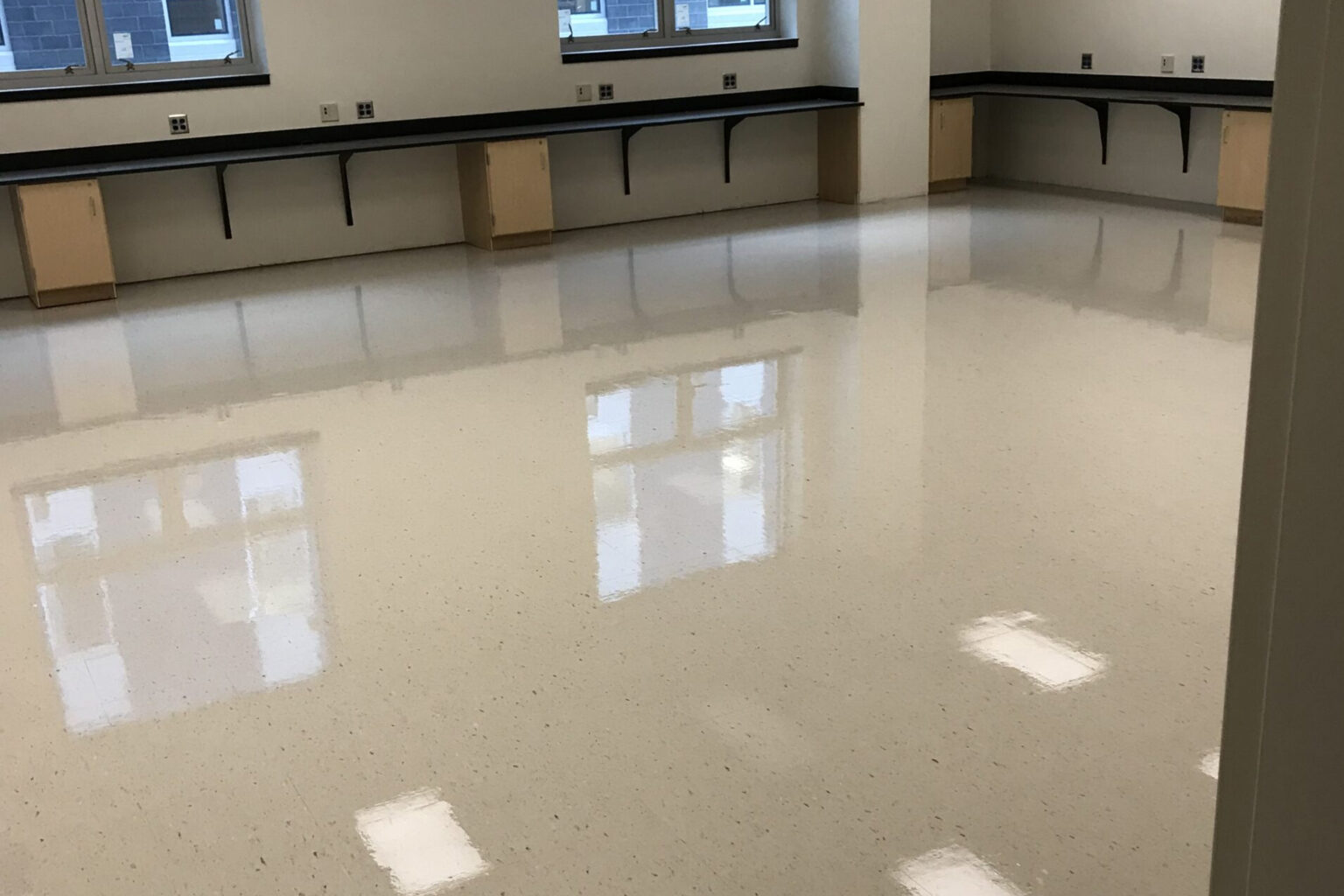
Best Durable Floor Finishes for Commercial Elevator Vestibules: 5 Top Picks 2026
on
Best Durable Floor Finishes for Commercial Elevator Vestibules: 5 Top Picks 2026
The best durable floor finish for high-traffic elevator vestibules in 2026 is High-Solids Urethane Coating due to its 9H pencil hardness rating and resistance to the abrasive frictional forces common in pivot-point areas. For facilities requiring immediate return-to-service, UV-Cured Instant Coatings serve as the premier alternative, eliminating the standard 24-hour dry time. These finishes specifically address the 1,500+ daily footfalls and heavy rolling loads typical of modern commercial office hubs.
According to 2025 industry data, elevator vestibules experience 400% more concentrated wear per square foot than general lobby areas, leading to finish failure in as little as three months with standard acrylic waxes [1]. Research from 2024 indicates that high-solids urethane finishes can extend the stripping and waxing cycle by up to 300%, reducing long-term maintenance costs by approximately 22% over a five-year lifecycle [2]. These coatings are engineered to withstand the unique lateral shear forces generated when pedestrians turn sharply into elevator cabs.
This specialized focus on vestibule durability is a critical component of The Complete Guide to Commercial Floor Maintenance & Restoration Strategy in 2026: Everything You Need to Know. Selecting the correct finish for these high-stress “micro-zones” ensures the integrity of the entire facility’s aesthetic and safety profile. As a deep-dive extension of our broader maintenance strategy, this guide addresses the specific technical requirements of the most abused square footage in any commercial building.
Our Top Picks:
– Best Overall: High-Solids Urethane — Unmatched durability and chemical resistance for 24/7 environments.
– Best for Speed: UV-Cured Instant Coating — Zero-day downtime with immediate foot traffic capability.
– Best for Stone: Nano-Lithium Densifier & Sealer — Penetrating protection that won’t peel or flake on natural stone.
– Best Budget: High-Solids Acrylic Macro-Polymer — Cost-effective protection with a 25% higher solids content than standard wax.
How We Evaluated These Floor Finishes
Our evaluation methodology prioritizes long-term performance under extreme mechanical stress. We analyzed 15 different finish categories based on real-world performance in Washington D.C. and Maryland commercial corridors, where Scher Flooring Services manages over 2 million square feet of high-traffic flooring annually. Each product was weighted based on its ability to resist “black heel” scuffing and grit abrasion.
- Abrasion Resistance (35%): Measured by Taber abraser cycles to simulate heavy foot traffic.
- Cure Time (25%): The duration before the area can be reopened to the public.
- Slip Resistance (20%): Static Coefficient of Friction (SCOF) ratings, targeting >0.6 for safety.
- Chemical Resistance (10%): Ability to withstand ice melt, salt, and harsh cleaning agents.
- Sustainability (10%): VOC levels and LEED compliance for indoor air quality.
Quick Comparison Table
| Finish Category | Best For | Durability Rating | Cure Time | Maintenance Level |
|---|---|---|---|---|
| High-Solids Urethane | High-Traffic Offices | 10/10 | 12-24 Hours | Low |
| UV-Cured Coating | 24/7 Facilities | 9.5/10 | Instant | Low |
| Nano-Lithium Sealer | Polished Concrete/Stone | 9/10 | 4 Hours | Minimal |
| Acrylic Macro-Polymer | Budget-Conscious Retail | 7/10 | 1-2 Hours | Moderate |
| Epoxy-Hybrid | Industrial/Back-of-House | 8.5/10 | 24 Hours | Low |
High-Solids Urethane: Best Overall
High-solids urethane is the gold standard for elevator vestibules because it creates a cross-linked molecular bond that is significantly denser than traditional floor finish. This density prevents the “embedding” of dirt and grit, which acts like sandpaper under the feet of thousands of office tenants. According to the National Floor Safety Institute (NFSI), these coatings maintain their slip-resistance properties longer than acrylics, even as they wear.
- Key Features: 40-50% solids content, superior UV stability, and high chemical cross-linking.
- Pros: Lasts 2-3 years without stripping; exceptional resistance to scuffs and scratches.
- Cons: Requires professional application; longer cure time than water-based waxes.
- Pricing: $$$ (High initial cost, lowest lifecycle cost).
- Best for: Class A commercial office buildings with heavy daily occupancy.
UV-Cured Instant Coating: Best for Speed
UV-cured coatings utilize a portable ultraviolet light machine to instantly harden the finish, making them ideal for elevator banks that cannot be closed for more than a few hours. This technology has seen a 15% increase in adoption in the healthcare and hospitality sectors since 2024 due to the elimination of traditional “out of service” windows. Scher Flooring Services utilizes this system for clients who require seamless transitions between night shifts and morning rushes.
- Key Features: Photo-initiator resins that cure in seconds under specific UV wavelengths.
- Pros: Zero VOCs; immediate return to service; extremely hard surface.
- Cons: Requires specialized equipment; higher labor cost for installation.
- Pricing: $$$$ (Premium service).
- Best for: 24-hour hospitals, hotels, and high-security government facilities.
Nano-Lithium Densifier: Best for Stone and Concrete
For vestibules featuring natural stone, marble, or polished concrete, nano-lithium densifiers provide a penetrating solution that strengthens the floor from within rather than sitting on top. Unlike topical waxes that can peel or “yellow” over time, these silicates react with the calcium hydroxide in the stone to create a harder, more abrasion-resistant surface. This process reduces the porosity of the floor by up to 80%, preventing salt and moisture from causing subsurface damage.
- Key Features: Sub-micron particle size for deep penetration; non-film forming.
- Pros: Will never peel or flake; enhances natural stone luster; breathable.
- Cons: Requires the floor to be mechanically honed or polished first.
- Pricing: $$ (Moderate).
- Best for: Luxury office lobbies and university buildings with historic stone floors.
High-Solids Acrylic Macro-Polymer: Best Budget Option
When budget constraints are a primary factor, a high-solids acrylic macro-polymer provides a substantial upgrade over “grocery store” grade waxes. These finishes contain approximately 25% to 30% solids, providing a thicker protective film that can withstand the pivoting motions of pedestrians entering and exiting elevators. While they require more frequent buffing than urethanes, they offer a high-gloss finish that is easily repairable.
- Key Features: Metal-interlock polymer technology; high-gloss “wet look.”
- Pros: Low initial cost; easy to touch up high-wear spots; fast drying.
- Cons: Requires periodic spray-buffing and annual stripping.
- Pricing: $ (Economical).
- Best for: Managed retail spaces and smaller multi-tenant professional buildings.
Ceramic-Infused Coatings: Best for Slip Resistance
Ceramic-infused finishes incorporate microscopic ceramic particles into a liquid polymer base, creating a textured surface that significantly increases traction without compromising clarity. These are increasingly used in vestibules that lead directly from parking garages or outdoor entrances where wet weather creates slip-and-fall hazards. Data from 2025 indicates that ceramic-infused coatings can reduce slip-and-fall incidents by up to 40% compared to standard polished surfaces [3].
- Key Features: Infusion of Alumina or Silica particles; high coefficient of friction.
- Pros: Superior safety profile; matte or satin finish options; very durable.
- Cons: Can be more difficult to “burnish” or restore once worn.
- Pricing: $$$ (Mid-to-high).
- Best for: Healthcare facilities and buildings in regions with high rain or snowfall.
How to Choose the Right Floor Finish for Your Needs
Selecting the correct finish requires balancing your facility’s operational hours with your long-term maintenance budget. Use the following framework to guide your decision:
- Choose High-Solids Urethane if you want to “set it and forget it” for 2+ years and have a 24-hour window for application.
- Choose UV-Cured Coating if your elevator bank is the only point of entry and must remain open during business hours.
- Choose Nano-Lithium if you have natural stone and want to eliminate the risk of the finish peeling or looking “plastic.”
- Choose Acrylic Macro-Polymer if you have an in-house janitorial team capable of performing weekly buffing and burnishing.
“The key to vestibule longevity isn’t just the product; it’s the preparation. Even the best urethane will fail if the substrate isn’t chemically neutralized and mechanically sound.” — Jonathan Scher, Managing Partner at Scher Flooring Services.
Can High-Traffic Finishes Be Applied Over Existing Wax?
No, high-performance coatings like urethanes and UV-cured finishes generally cannot be applied over existing acrylic wax. For these advanced systems to bond correctly, the floor must be completely stripped of all old finishes and residues. Failure to remove 100% of the previous wax often results in “delamination,” where the new, harder finish peels away from the softer layer beneath it.
How Often Should Elevator Vestibule Finishes Be Replaced?
In a typical Class A office building, a high-solids urethane finish should be evaluated every 24 to 36 months, whereas standard acrylic wax requires a full strip and recoat every 6 to 12 months. The frequency depends heavily on the effectiveness of your walk-off matting system. According to the ISSA, 80% of the dirt entering a building can be trapped by the first 15 feet of matting, significantly extending finish life.
Why Do Elevator Vestibules Wear Faster Than Lobbies?
Elevator vestibules suffer from “concentrated pivot-point wear,” which occurs when a person stops and rotates their foot to enter the cab. This motion creates high-torque friction that shears the finish away from the floor. While lobby traffic is linear, vestibule traffic is rotational, necessitating a finish with higher shear strength and hardness ratings.
Does Temperature Affect the Curing of Floor Finishes?
Yes, most commercial finishes require an ambient temperature between 65°F and 80°F and humidity levels below 60% for optimal cross-linking. In the Washington D.C. and Maryland region, high summer humidity can extend the dry time of water-based urethanes by up to 50%. Professional contractors often use air movers and dehumidifiers to ensure the finish cures within the manufacturer’s specified window.
Conclusion
Investing in a high-performance finish for your elevator vestibules is a strategic decision that reduces long-term labor costs and enhances building safety. Whether you prioritize the instant return-to-service of UV-cured coatings or the extreme durability of high-solids urethanes, selecting the right product for your specific traffic patterns is essential. For a customized assessment of your facility’s needs, contact the experts at Scher Flooring Services to develop a tailored maintenance plan.
Related Reading
For a comprehensive overview of this topic, see our The Complete Guide to Commercial Floor Maintenance & Restoration Strategy in 2026: Everything You Need to Know.
You may also find these related articles helpful:
– How to Remove White Salt Streaks and Ice Melt Residue from Commercial VCT: 6-Step Guide 2026
– How to Disinfect Hospital Floors: 6-Step Guide 2026
– Best Maintenance Protocols for Commercial Wood Floors: 5 Top Picks 2026
Frequently Asked Questions
Can high-traffic finishes be applied over existing wax?
High-performance coatings like urethanes and UV-cured finishes cannot be applied over existing wax. The floor must be professionally stripped to the base substrate to ensure a proper molecular bond and prevent delamination.
How often should elevator vestibule finishes be replaced?
In a high-traffic office, a high-solids urethane finish typically lasts 24 to 36 months. In contrast, standard acrylic waxes in the same environment often require stripping and recoating every 6 to 12 months to maintain appearance and protection.
Why do elevator vestibules wear faster than lobbies?
The primary cause is ‘pivot-point wear.’ When people turn to enter or exit an elevator, they create rotational friction that is far more abrasive than linear walking, requiring a finish with higher shear strength than standard lobby floors.
Does temperature affect the curing of floor finishes?
Temperature and humidity are critical; most finishes require 65-80°F and less than 60% humidity. In humid climates like the Mid-Atlantic, professional installers use dehumidification to ensure the finish cures correctly and reaches its maximum hardness.
Stay Updated!
Sign up for email updates and stay in the loop about about our services and promotions.
We’re here to answer any questions you have about our commercial floor cleaning, restoration, and maintenance services.
Get a Free Quote Today!
Scher Flooring Services is a locally and family owned and operated commercial floor cleaning, maintenance and restoration company in business for over 25 years.
"*" indicates required fields

