Cylindrical Brush vs Rotary Brush for Carpets: Which Is Better for Commercial Carpet Cleaning?
on
Cylindrical brush vs rotary brush for carpets is an important decision for any business that wants cleaner floors without shortening the life of its carpet. In most commercial carpet cleaning programs, cylindrical brushes are usually the better choice for commercial loop pile, while rotary brushes should be used carefully and only when the carpet type, soil load, and manufacturer guidance support it.
The reason comes down to motion. Rotating cylindrical brushes lift and separate carpet fibers with a vertical brushing action. Traditional rotary machines move in a flat circular pattern, which can be helpful on some hard surfaces but more aggressive on certain commercial carpets.
For facility managers, property managers, schools, hotels, offices, medical buildings, and retail spaces, the goal is not just to make carpet look clean for a few days. The goal is to remove soil, protect fibers, reduce downtime, and maintain a professional appearance over thousands of square feet.
Quick Answer: Cylindrical Brush vs Rotary Brush for Carpets
Cylindrical brushes are generally better for commercial carpets, especially commercial loop pile, because they lift carpet pile, loosen dirt, and work cleaning solution through the fibers with less side-to-side friction. Rotary brushes can still have a place in certain carpet cleaning situations, but they carry a higher risk of fuzzing, pile distortion, and fiber stress when used incorrectly.
For most routine commercial maintenance, cylindrical brush systems are preferred because they support low-moisture cleaning, faster drying, and more consistent cleaning results across large areas. Rotary equipment may be better suited for specific restorative work, but only after testing and fiber inspection.
Here is the simple comparison:
| Cleaning factor | Cylindrical brush systems | Rotary brush machines |
| Brush motion | Two counter rotating brushes move in opposite directions | One circular brush or pad rotates flat against the surface |
| Best use | Commercial carpets, low-moisture cleaning, pile lifting | Select restorative cleaning, some hard surfaces, certain cut pile carpets |
| Carpet safety | Usually safer for loop pile when used correctly | Higher risk on commercial loop pile |
| Soil removal | Good for lifting dirt, dust, hair, and debris | Can scrub surface soil but may flatten pile |
| Drying time | Often faster with low-moisture systems | Depends on method and solution volume |
| Facility downtime | Usually lower | Can be higher with wet methods |
| Main risk | Wrong brush bristles or too many passes | Fiber distortion, swirl marks, overwetting, pile damage |
For a commercial facility, the better job is usually not the most aggressive job. It is the one that removes soil while protecting carpet life. That makes brush technology the next important piece of the decision.
Why Brush Technology Matters in Commercial Carpet Cleaning
Brush technology matters because carpet does not clean like tile, concrete, vinyl, or other flat hard surfaces. Dirt settles between carpet fibers, works into the pile, and becomes abrasive when people walk over it. If the wrong machine is used, the carpet may look cleaner for a short time but wear out faster.
In commercial floor cleaning, agitation is one part of the process. Vacuuming removes dry soil. Pre spray and cleaning solution help break the bond between soil and fibers. Brushes work the chemistry through the carpet so suspended dirt can be removed. When these steps are balanced, the carpet gets cleaner without unnecessary damage.
This is why commercial carpet care should be tied to a full maintenance strategy, not a one-time machine choice. A facility with office carpet tiles, hotel corridors, school hallways, and lobby walk-off areas may need different cleaning frequencies and methods. Scher Flooring Services addresses this through commercial carpet cleaning services and scheduled maintenance programs that match the floor type, traffic level, and business use.
How Agitation Helps Remove Soil From Commercial Carpets
Agitation helps loosen soil that vacuuming alone cannot remove. In busy commercial carpets, dry dirt, dust, oily residue, spills, and debris settle below the surface. Foot traffic pushes this material deeper into the pile.
Good agitation helps:
- Spread the cleaning solution evenly
- Break up traffic lane soil
- Lift compacted pile
- Release embedded dirt from carpet fibers
- Improve extraction or encapsulation results
- Reduce the chance of stains returning after cleaning
This is closely connected to soil suspension, which is the process of separating soil from the fiber so it can be removed instead of smeared around. Scher’s article on soil suspension in commercial carpet cleaning explains why proper chemistry, agitation, dwell time, and removal all need to work together.
Why the Wrong Brush Can Damage Carpet Fibers
Brushes are not automatically safe just because they clean well. Brush bristles that are too stiff, too aggressive, or moving in the wrong direction can stress carpet fibers. This is especially important for commercial loop pile because the yarn loops can fuzz, bloom, or distort if the machine pulls across the surface too aggressively.
The wrong equipment can create:
- Fuzzy or frayed carpet tips
- Flattened traffic lanes
- Swirl marks
- Uneven pile direction
- Faster wear in walk paths
- Poor appearance after drying
That is why the next question is not only whether brushes are useful. It is how different brushes move through the carpet. The first option to understand is cylindrical brush cleaning.
What Are Cylindrical Brushes in Carpet Cleaning?
Cylindrical brushes are long roller-style brushes that rotate vertically instead of spinning flat against the carpet. In carpet cleaning, they are often used in cylindrical machines or cylindrical scrubbers designed to lift the pile, loosen soil, and distribute pre spray or encapsulation chemistry more evenly.
This style of brush is common in counter rotating brush systems. In many commercial cleaning setups, the machine uses two counter rotating brushes that spin in opposite directions. This gives the carpet a lifted and groomed look while helping soil move away from the base of the pile.
How Rotating Cylindrical Brushes Work
Rotating cylindrical brushes work by brushing through the carpet pile from the side and underside of the fibers rather than dragging across the top in a flat circle. The brush bristles comb the pile, separate fibers, and help loosen dirt.
In simple terms, cylindrical brushes do three things at once:
- Lift the pile
- Agitate the cleaning solution
- Pull loosened debris upward for removal
This is why cylindrical equipment can be effective in large areas where consistent results matter. In offices, hotels, apartment common areas, and schools, one of the biggest challenges is not just stains. It is the dull, dirty look caused by embedded soil and crushed pile.
Why a Counter Rotating Brush Is Common in Low-Moisture Carpet Cleaning
A counter rotating brush is common in low-moisture carpet cleaning because the two brushes scrub simultaneously while moving in opposite directions. This action helps open the pile and work the cleaning solution around the fibers without soaking the backing.
Low-moisture systems are often used with encapsulation carpet cleaning. In that process, chemistry surrounds or crystallizes soil so it can be removed after drying through vacuuming. For businesses that cannot keep areas closed for long periods, this can be a practical option. Scher explains this further in its guide to encapsulation carpet cleaning for commercial spaces.
Where Cylindrical Scrubbers Perform Best in Commercial Facilities
Cylindrical scrubbers perform best where a facility needs steady, repeatable cleaning across large carpeted spaces. They are often suitable for:
- Office corridors
- Hotel hallways
- School carpeted areas
- University buildings
- Apartment common areas
- Retail carpet zones
- Conference rooms
- High-traffic commercial carpet tiles
They can also create labor savings because they cover broad sections efficiently and reduce the need for repeated passes when paired with the right chemistry. However, the machine still needs to be selected correctly. Soft, medium, and stiff brushes all behave differently, and nylon or synthetic fibers may respond differently depending on pile type.
Cylindrical machines are often the better option for carpet, but rotary equipment is still common in the floor care industry. Understanding how rotary motion works helps explain why it must be used with more caution on commercial carpets.
What Is a Rotary Brush or Rotary Floor Scrubber?
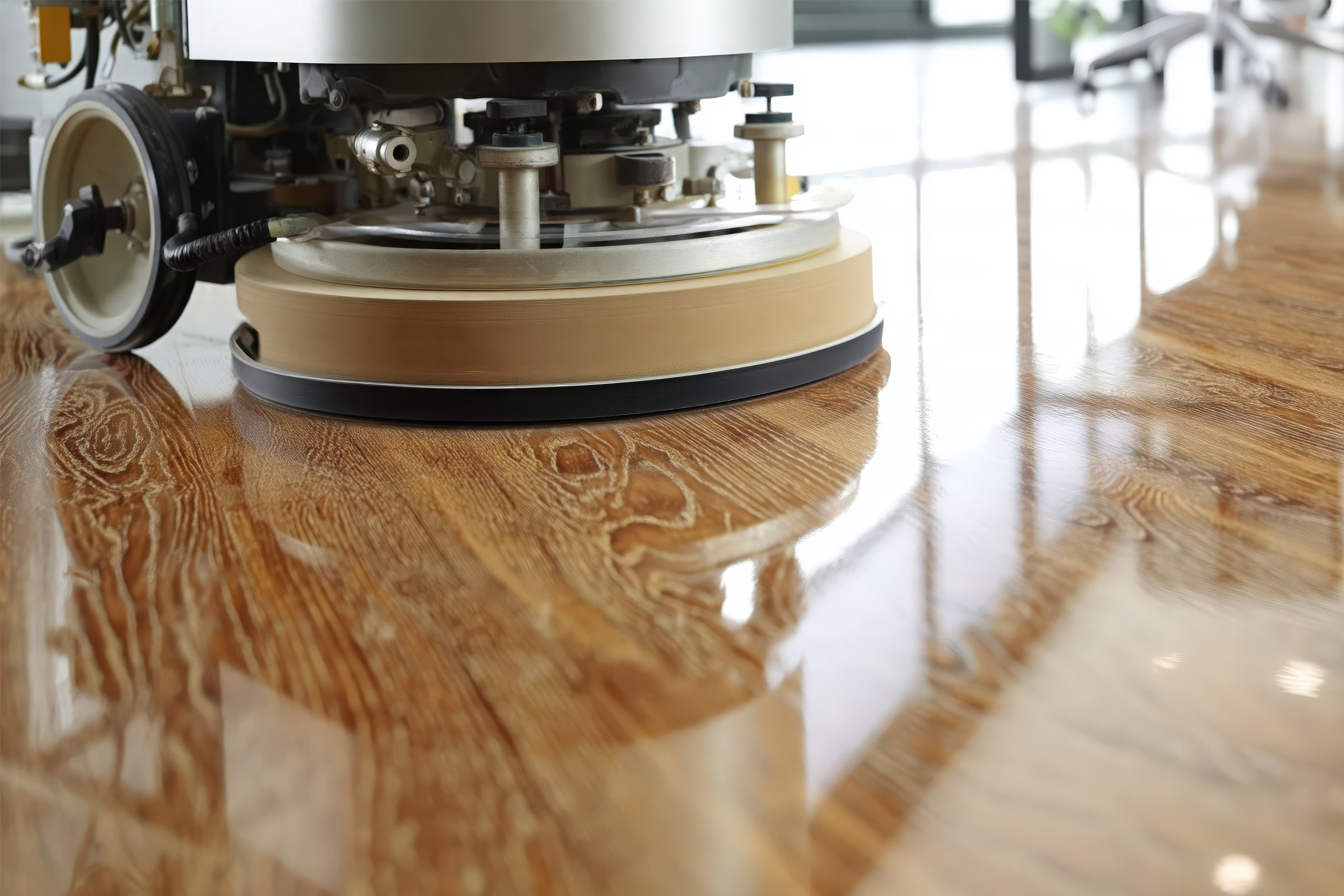
A rotary brush or rotary floor scrubber uses a circular brush, pad, bonnet, or driver that spins flat against the surface. This design is common with disc machines and disc scrubber equipment used for tile, concrete, VCT, and other hard surfaces.
On hard surfaces, rotary machines can be useful for scrubbing, polishing, and restorative work. For example, a rotary or disc machine may help strip wax from VCT floors or scrub grout lines on tile when the correct pad, brush, and solution are used. Scher’s VCT floor cleaning services and commercial tile floor cleaning show where hard surface methods fit into a broader floor care program.
Carpet is different. A flat circular motion can create more lateral friction than a cylindrical system. That is why rotary brush cleaning needs careful judgment.
How a Rotary Brush Floor Scrubber Cleans Carpet Surfaces
A rotary brush floor scrubber cleans by spinning a brush or pad against the carpet surface. The machine spreads cleaning solution, agitates the top of the pile, and can help break apart oily soil or stains.
This can be useful when a carpet needs heavier correction, but it is not always gentle. Since the movement is circular, the machine may push and twist fibers instead of lifting them upright. On some carpets, especially delicate or looped products, this can lead to visible distortion.
Where Rotary Brush Cleaning Can Be Useful
Rotary brush cleaning may still make sense in certain cases, such as:
- Heavily soiled cut pile carpet
- Restorative cleaning after long neglect
- Some spot treatment work
- Carpet that has been tested and approved for rotary agitation
- Areas where manufacturer guidelines allow it
- Certain commercial jobs where aggressive scrubbing is needed before extraction
The key is not to assume that more scrubbing means a better result. In commercial floor care, the right equipment depends on materials, traffic level, soil load, moisture tolerance, and carpet construction.
Why Rotary Motion Can Be Risky for Some Carpet Types
Rotary motion can be risky because it creates side pressure on the pile. On commercial loop pile, that pressure may pull at the loops and create texture changes. It may also flatten the carpet instead of lifting it.
Possible issues include:
- Blooming
- Fuzzing
- Pile distortion
- Circular marks
- Uneven drying
- Over-scrubbing of traffic lanes
- Fiber damage on lower-quality carpet
This is why the most important comparison is not just cylindrical vs rotary in general. It is how both systems behave on commercial loop pile, which is one of the most common carpet types in business facilities.
Cylindrical Brush vs Rotary Brush for Commercial Loop Pile Carpet
Commercial loop pile carpet is built for durability, but it still needs the right maintenance method. The looped construction handles traffic well, yet it can be sensitive to aggressive brushing, harsh pads, and sideways scrubbing.
For many commercial loop pile carpets, cylindrical brushes are the safer choice because they lift and separate the pile instead of twisting against it. Rotary brush systems may be too aggressive unless the carpet manufacturer allows the method and the technician has tested the area first.
Why Commercial Loop Pile Needs Gentler Agitation
Commercial loop pile is made with yarn loops that remain uncut. These loops help the carpet resist crushing and heavy traffic, but they can also snag, fuzz, or bloom if the cleaning method pulls at them.
Gentler agitation matters because commercial loop pile is often used in:
- Offices
- Hotels
- Schools
- Healthcare buildings
- Government facilities
- Retail spaces
- Property management common areas
These are not low-use spaces. They collect dirt, stains, dust, hair, and debris daily. Cleaning must be strong enough to remove soil but controlled enough to protect the construction.
Pile Lifting, Soil Removal, and Fiber Protection
Cylindrical brushes are often preferred because they lift the pile while loosening dirt. When the pile is lifted, the cleaning solution can reach more of the fiber surface. When the soil is loosened, vacuuming, encapsulation, or extraction can remove it more effectively.
This supports three goals at once:
| Goal | Why it matters |
| Pile lifting | Helps carpet look more uniform and less crushed |
| Soil removal | Reduces abrasive dirt that wears down fibers |
| Fiber protection | Helps extend carpet life and preserve appearance |
Rotary machines may remove surface soil, but they do not always lift the pile in the same controlled way. On loop pile, that difference matters.
Which Method Is Safer for High-Traffic Commercial Carpets?
For high-traffic commercial carpets, cylindrical brush cleaning is usually safer for regular maintenance. It is especially useful when paired with low-moisture cleaning or encapsulation because it allows the carpet to dry faster and return to service sooner.
Rotary brush cleaning may still be useful for select restorative jobs, but it should not be the default method for every facility. The right approach is to inspect the carpet, identify the fiber and pile type, choose the correct brush, and match the method to the expected result.
The next step is to compare the machines directly, including soil removal, drying time, risk, and long-term cost.
Comparing Cylindrical Scrubbers and Rotary Floor Scrubber Machines
Cylindrical scrubbers and rotary floor scrubber machines can both clean, but they clean differently. For commercial carpets, the difference between lifting and twisting can affect cleaning results, drying time, appearance, and total floor maintenance cost.
A facility manager should not choose based only on the machine name. The better choice depends on how the machine contacts the carpet, how much solution is used, and how much risk the carpet can tolerate.
Soil Removal Performance
Cylindrical machines are strong for soil removal because the brushes reach into the pile and pull debris upward. This helps with dry soil, dust, hair, loose dirt, and compacted traffic lane soil.
Rotary machines can scrub surface soil aggressively, but they may push soil around if there is not enough vacuum recovery, extraction, or proper chemistry. On carpet, scrubbing alone is not the same as full soil removal.
For best results, soil should be:
- Loosened
- Suspended
- Lifted or extracted
- Removed by vacuuming or recovery equipment
- Prevented from reattaching to fibers
Drying Time and Facility Downtime
Cylindrical brush systems are often used with low-moisture methods, which can reduce drying time. That matters for businesses that cannot close hallways, office spaces, classrooms, or hotel corridors for long periods.
Rotary methods may use more solution depending on the system. If the carpet becomes too wet, it can lead to longer drying, odor concerns, wick-back stains, or disruption to normal business use.
For commercial facilities, drying time is not just a cleaning detail. It affects safety, scheduling, and customer experience.
Risk of Fuzzing, Matting, or Fiber Distortion
Cylindrical brushes usually have a lower risk of distortion when the correct brush bristles are selected. They brush through the pile instead of creating a flat circular drag.
Rotary machines can increase the risk of:
- Fuzzing
- Matting
- Blooming
- Swirl marks
- Pulled loops
- Fiber stress
This is why rotary cleaning should be tested before full use on commercial loop pile carpet.
Maintenance Cost and Long-Term Carpet Life
The cheapest cleaning method is not always the least expensive over time. If a machine damages carpet fibers, causes recurring stains, or shortens the life of the carpet, the facility may pay more through premature replacement.
A well-designed commercial floor maintenance plan helps control those costs by matching cleaning frequency and equipment to real traffic patterns.
Cylindrical brush systems are often the better maintenance choice. Now it helps to look at specific situations where they make the most sense.
When Cylindrical Brushes Are the Better Choice
Cylindrical brushes are the better choice when the facility needs routine maintenance, pile lifting, low-moisture cleaning, and lower downtime. They are especially helpful in commercial environments where carpet gets dirty quickly but cannot be taken out of service for a long time.
This is why many commercial carpet cleaning programs use cylindrical machines as part of a scheduled system rather than waiting until carpet looks dirty.
Office Buildings, Schools, Hotels, and Healthcare Facilities
Cylindrical brushes work well in occupied buildings because they can help maintain appearance with less disruption. Offices, schools, hotels, and healthcare facilities all deal with high foot traffic, spills, tracked-in soil, and time-sensitive cleaning schedules.
Examples include:
- Office hallways with daily employee traffic
- Hotel corridors with luggage wheels and food spills
- School carpet with dust, dirt, and outdoor debris
- Healthcare waiting areas where appearance and cleanliness matter
- Apartment common areas with pet hair and tracked-in soil
These facilities need regular cleaning, not occasional aggressive correction.
Low-Moisture Maintenance Programs
Low-moisture maintenance is one of the strongest use cases for cylindrical brushes. The brushes help distribute cleaning solution while lifting the pile. This can reduce drying time and help the carpet return to use faster.
This matters in businesses where wet carpet creates problems, such as:
- Slip risk near transitions
- Musty odors
- Delayed reopening
- Complaints from occupants
- Stains returning after slow drying
Regular Cleaning for High-Traffic Commercial Carpets
High-traffic carpet needs consistency. If cleaning happens only after carpet looks dirty, abrasive soil may already be damaging the fibers. Cylindrical brush cleaning can be part of a recurring plan that maintains appearance before the carpet declines.
A good program may include:
- Daily or frequent vacuuming
- Spot cleaning for stains
- Scheduled low-moisture cleaning
- Periodic deep clean or extraction
- Entry mat maintenance
- Seasonal adjustments for snow, salt, rain, or mud
Cylindrical brushes are usually the stronger maintenance tool, but there are still cases where rotary brush cleaning may be considered.
When Rotary Brush Carpet Cleaning May Still Make Sense
Rotary brush carpet cleaning may still make sense when the carpet is heavily soiled, the pile type can tolerate it, and a trained professional has tested the method first. It should not be treated as a universal carpet cleaning solution.
In commercial floor cleaning, rotary machines are valuable tools. They are widely used on hard surfaces for scrubbing, polishing, and restorative work. The caution is specific to carpet, especially commercial loop pile.
Heavy Soil, Grease, or Restorative Cleaning Situations
Some carpets need more than interim maintenance. Grease, food spills, heavy soil, and neglected traffic lanes may require stronger agitation before extraction.
Rotary equipment may be considered when:
- The carpet is not responding to lighter methods
- The fiber and pile type can handle the motion
- A test area shows no visible damage
- The cleaning technician controls moisture carefully
- The manufacturer’s guidelines do not prohibit the method
Even then, rotary cleaning should be used as part of a complete process, not as a shortcut.
Cut Pile Carpet vs Commercial Loop Pile Carpet
Cut pile carpet may tolerate rotary agitation better than commercial loop pile in some cases. Since the yarn tips are cut instead of looped, there may be less risk of pulling loops. However, cut pile can still fuzz, mat, or distort if the brush is too aggressive.
Commercial loop pile requires more caution. The looped structure is durable under foot traffic but vulnerable to certain brushing directions. That is why cylindrical brush systems are often safer for routine care.
Why Professional Testing Matters Before Using Rotary Equipment
Testing matters because two carpets can look similar but react differently. Fiber type, backing, age, soil load, previous cleaning residue, and installation method can all affect the outcome.
Before using rotary equipment, a professional should check:
- Carpet manufacturer guidance
- Fiber type
- Pile construction
- Existing wear
- Soil level
- Dye stability
- Moisture sensitivity
- Brush or pad aggressiveness
This is where experience matters. Scher Flooring Services works with commercial facilities where cleaning has to balance appearance, safety, downtime, and flooring life. That practical judgment is the difference between cleaning a carpet and protecting a carpet.
Best Recommendation for Commercial Floor Cleaning Clients
For most commercial floor cleaning clients, cylindrical brush cleaning is the better starting point for commercial carpets. It supports routine maintenance, helps lift pile, improves soil suspension, and reduces unnecessary stress on fibers.
Rotary brush cleaning should be treated as a selective tool, not the default method for every carpet. It can be useful in certain restorative situations, but only with proper testing and professional control.
Why Cylindrical Brush Cleaning Is Usually Better for Commercial Loop Pile
Cylindrical brush cleaning is usually better for commercial loop pile because the motion works with the pile instead of against it. The brushes lift, separate, and agitate without the same circular dragging force that comes from traditional rotary machines.
For facility managers, this means:
- Lower risk of fiber distortion
- Better pile lifting
- More consistent cleaning across large areas
- Faster drying with low-moisture methods
- Less disruption to the business
- Better long-term maintenance value
Why Rotary Brushes Should Be Used Carefully and Selectively
Rotary brushes should be used carefully because they can be too aggressive for certain carpet types. A rotary brush may create strong surface agitation, but that does not automatically mean safer or deeper cleaning.
Use rotary methods only when:
- The carpet type allows it
- The brush or pad is appropriate
- The technician performs a test area
- Moisture is controlled
- The cleaning goal justifies the added risk
How a Custom Carpet Maintenance Plan Helps Protect Your Flooring Investment
A custom maintenance plan protects carpet by using the right method at the right time. Not every area needs the same cleaning schedule. A lobby, hallway, private office, elevator landing, and conference room all collect soil differently.
A strong commercial carpet maintenance plan may combine:
- Vacuuming
- Spot treatment
- Low-moisture cylindrical brush cleaning
- Periodic hot water extraction
- Entry mat care
- Stain tracking
- Seasonal cleaning adjustments
This approach helps maintain the carpet’s appearance and useful life while reducing emergency cleaning calls. It also gives the facility a better way to budget floor care instead of waiting until replacement becomes the only option.
Final Verdict: Which Brush Technology Is Better for Commercial Carpets?
Cylindrical brush technology is usually better for commercial carpets, especially commercial loop pile, because it lifts the pile, agitates soil, and supports low-moisture cleaning with less risk of fiber damage. Rotary brush technology can still be useful, but it should be used selectively and carefully.
The best answer is not that one machine is always good and the other is always bad. The best answer is that carpet cleaning should match the carpet construction, soil level, traffic pattern, and business schedule.
For routine commercial carpet maintenance, cylindrical brushes are usually the better choice. For heavily soiled or restorative situations, rotary cleaning may be considered after testing. For facilities with mixed flooring, the right provider should know when to use carpet-safe brush technology and when hard surface equipment is better suited for tile, concrete, VCT, or other floors.
Scher Flooring Services helps commercial facilities build practical floor care programs that protect appearance, safety, and long-term flooring value. For a business, that matters more than choosing the most aggressive machine. The right equipment should clean the carpet, protect the fibers, and support the way the facility actually operates.
FAQs About Cylindrical Brush vs Rotary Brush Carpet Cleaning
Are cylindrical brushes safe for commercial carpets?
Yes, cylindrical brushes are generally safe for many commercial carpets when the correct brush bristles, cleaning solution, and machine settings are used. They are often preferred for commercial loop pile because they lift and separate the pile rather than scrubbing in a flat circular pattern.
Can a rotary brush damage commercial loop pile carpet?
Yes, a rotary brush can damage commercial loop pile carpet if it is too aggressive or not approved for that carpet type. Possible issues include fuzzing, blooming, swirl marks, pulled loops, and pile distortion. A test area should always be performed before using rotary equipment on commercial carpet.
Are cylindrical scrubbers better for low-moisture carpet cleaning?
Cylindrical scrubbers are often better for low-moisture carpet cleaning because they help distribute pre spray or encapsulation chemistry while lifting the carpet pile. This can improve cleaning results and reduce drying time in busy commercial facilities.
What type of floor scrubber should be used on commercial carpets?
For commercial carpets, a counter rotating brush or cylindrical brush system is often the safer choice for routine cleaning. A rotary floor scrubber or disc scrubber may be useful for some hard surfaces and select restorative carpet cleaning tasks, but it should not be used on commercial loop pile without proper testing.
How often should commercial carpets be professionally cleaned?
Commercial carpets should be professionally cleaned based on traffic, soil level, building use, and appearance goals. High-traffic areas may need low-moisture maintenance more often, while deep cleaning may be scheduled periodically. Offices, schools, hotels, healthcare buildings, and retail facilities usually benefit from a custom maintenance plan instead of waiting until carpet looks visibly dirty.
Stay Updated!
Sign up for email updates and stay in the loop about about our services and promotions.
We’re here to answer any questions you have about our commercial floor cleaning, restoration, and maintenance services.
Get a Free Quote Today!
Scher Flooring Services is a locally and family owned and operated commercial floor cleaning, maintenance and restoration company in business for over 25 years.
"*" indicates required fields