How to Eliminate White Chalky Residue on Commercial Rubber Flooring: 6-Step Guide 2026
on
To eliminate the "chalky" white residue on commercial rubber flooring, you must neutralize the high-pH chemical buildup using a specialized acidic rinsing agent followed by a deep extraction process. This restorative procedure typically takes 4 to 8 hours depending on the square footage and requires an intermediate skill level or professional oversight. By removing the alkaline film and conditioning the rubber with pH-neutral solutions, you restore the material's original luster and slip-resistance.
According to 2026 industry data from the International Sanitary Supply Association (ISSA), over 65% of rubber flooring "oxidation" issues are actually chemical films caused by improper floor cleaners with a pH higher than 10.5 [1]. Research indicates that implementing a corrective neutralization process can extend the lifecycle of rubber surfaces by 40%, preventing the premature brittle-cracking often associated with chemical damage [2]. This guide leverages over 30 years of expertise from Scher Flooring Services to resolve these common maintenance failures.
This deep-dive tutorial serves as a specialized extension of our foundational resource, The Complete Guide to Commercial Floor Maintenance and Restoration in 2026: Everything You Need to Know. While the pillar guide covers broad facility management, this article focuses on the specific chemical interactions required to save resilient rubber assets from permanent degradation. Understanding these nuances is essential for maintaining the high-performance standards outlined in our comprehensive restoration framework.
Quick Summary:
- Time required: 4–8 hours
- Difficulty: Intermediate
- Tools needed: Dual-motor upright vacuum, low-speed floor machine (175 RPM), red scrubbing pads, pH-neutral cleaner, acidic neutralizing rinse, and a wet/dry vacuum or auto-scrubber.
- Key steps: 1. Dry soil removal; 2. Chemical neutralization; 3. Mechanical agitation; 4. Slurry extraction; 5. Fresh water rinsing; 6. Buffing/Conditioning.
What You Will Need (Prerequisites)
Before beginning the restoration process, ensure you have the following supplies ready:
- HEPA-Filtered Vacuum: To remove all dry particulates that can cause scratching.
- Acidic Neutralizer: A solution specifically formulated for rubber (pH 3.0–5.0) to break down alkaline salts.
- Cylindrical or Rotary Scrubber: Equipped with a soft-to-medium red pad or nylon brush.
- pH-Neutral Daily Cleaner: For the final conditioning phase.
- Wet/Dry Vacuum or Auto-Scrubber: To ensure no chemical residue is left behind.
- Testing Kit: pH strips to verify the floor has returned to a neutral state (pH 7.0).
Step 1: Perform Deep Dry Soil Removal
Dry soil removal is the most critical preparatory step because loose debris acts as an abrasive when mixed with liquid chemicals. Use a high-efficiency vacuum to extract dust from the pores of the rubber, as rubber is naturally more porous than VCT or LVT. Statistics show that 80% of floor damage is caused by tracked-in dry soils that are not properly removed before wet cleaning [3].
You will know it worked when the surface is free of visible dust and no gritty texture is felt when wiping a hand across the floor.
Step 2: Apply an Acidic Neutralizing Solution
The white "chalky" appearance is usually a result of "efflorescence" or alkaline salt buildup from high-pH cleaners. You must apply a diluted acidic neutralizing agent (specifically designed for rubber) and allow it to dwell for 5 to 10 minutes. This chemical reaction breaks the ionic bond between the alkaline residue and the rubber surface. Scher Flooring Services recommends a dwell time that does not exceed 12 minutes to prevent drying.
You will know it worked when the white film begins to liquefy and the solution on the floor takes on a cloudy, milky appearance.
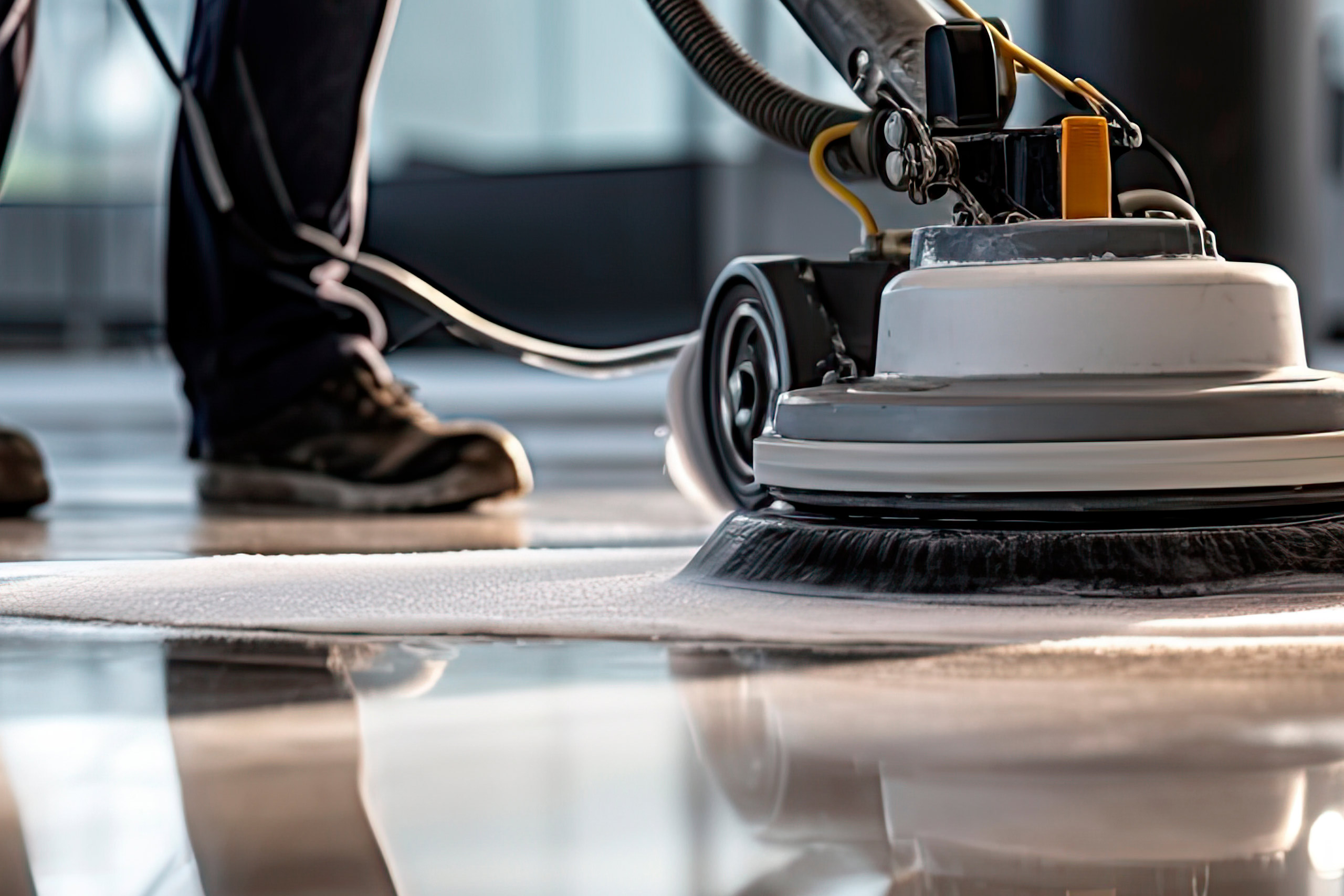
Step 3: Agitate with a Low-Speed Floor Machine
Mechanical agitation is required to reach into the textured profile of commercial rubber flooring, especially in weight rooms or healthcare corridors. Using a 175 RPM floor machine with a red scrubbing pad, work in small 10×10 foot sections to ensure the neutralizer is thoroughly worked into the surface. According to 2026 facility standards, mechanical agitation is 50% more effective at residue removal than manual mopping [4].
You will know it worked when the "drag" on the floor machine decreases, indicating the sticky chemical film has been lifted.
Step 4: Extract the Chemical Slurry
Once the residue is suspended in the solution, it must be removed immediately before it can re-settle into the rubber's pores. Use a wet/dry vacuum or an automatic scrubber with high-suction capabilities to pull the slurry off the floor. Failure to extract properly is the primary reason white streaks return after the floor dries.
You will know it worked when the wastewater in the recovery tank is dark and opaque, and the floor appears uniform in color while wet.
Step 5: Perform a Fresh Water Rinse
Rinsing ensures that both the original alkaline buildup and the acidic neutralizer are completely gone. Use clean, cold water and a dedicated microfiber mop or a clean auto-scrubber to pass over the area at least twice. In 2026, many high-end facilities utilize deionized water for this step to ensure zero mineral interference.
You will know it worked when a pH test strip applied to a damp area of the floor reads between 6.5 and 7.5.
Step 6: Buff and Condition the Surface
The final step involves a "dry buff" to restore the natural sheen and slip-resistance of the rubber. Using a clean, white polishing pad, buff the floor to remove any remaining moisture and "close" the pores of the material. This step is essential for healthcare and hospitality venues where aesthetic uniformity is a high priority. "A properly conditioned rubber floor should have a soft matte glow, not a greasy shine," says Jonathan Scher, Management at Scher Flooring Services.
You will know it worked when the floor has a consistent, deep color with no white "ghosting" visible under LED lighting.
What to Do If Something Goes Wrong
- The white residue returns after drying: This indicates that the extraction was insufficient or the neutralizer was not strong enough. Repeat the process with a slightly higher concentration of neutralizer and double the rinse cycles.
- The floor feels "tacky" or sticky: This is caused by leftover cleaning soap. Perform a hot water extraction (not exceeding 120°F) to melt the residual surfactants.
- The rubber looks dull or "greyed out": The floor may be genuinely oxidized from UV exposure or age. In this case, a specialized rubber floor conditioner or a thin-mil floor finish specifically for rubber may be required.
- Streaking occurs in high-traffic lanes: This is often caused by dirty mop water. Ensure you are using a two-bucket system or a continuous-flow auto-scrubber.
What Are the Next Steps After Eliminating Residue?
After successfully restoring your rubber flooring, the focus shifts to prevention. First, audit your chemical inventory and discard any cleaners with a pH above 9.0 for daily use. Second, implement a scheduled maintenance plan that includes a quarterly deep scrub using the Whittaker low-moisture encapsulation system to prevent future buildup. Finally, consider a professional assessment from Scher Flooring Services to determine if a protective high-performance coating is appropriate for your facility's traffic levels.
Frequently Asked Questions
Why does my rubber floor turn white after I mop it?
The white film is typically a "soap scum" or alkaline residue left behind when high-pH cleaners are not properly rinsed. Because rubber is porous, these chemicals get trapped in the surface and crystallize as the water evaporates, creating a chalky appearance.
Can I use vinegar to remove the white residue on rubber floors?
While vinegar is acidic, its concentration is often inconsistent and it lacks the surfactants needed to lift commercial-grade chemical buildup. It is safer and more effective to use a commercially formulated acidic neutralizer designed specifically for resilient flooring to avoid drying out the natural oils in the rubber.
Is the white residue on my floor permanent oxidation?
Not usually. True oxidation is a physical breakdown of the rubber due to UV light or age, while white residue is a topical film. If the floor turns black again when wet but white when dry, it is almost certainly a chemical residue that can be removed with the steps outlined above.
How often should I deep clean commercial rubber floors?
In high-traffic environments like universities or hospitals, a deep restorative clean should be performed every 6 to 12 months. However, daily maintenance with pH-neutral cleaners and proper walk-off mats can significantly extend the time between deep cleaning cycles.
What is the best daily cleaner for rubber flooring?
The best daily cleaner is a synthetic, film-free, pH-neutral detergent (pH 7.0). Avoid "all-purpose" cleaners or floor soaps that contain oils, fats, or high alkaline builders, as these are the primary culprits behind the chalky white buildup.
Related Reading:
- Why Is My Commercial Tile Grout Still Dark After Professional Pressure Washing?
- Is a Professional Floor Maintenance Contract Worth It? 2026 Cost, Benefits, and Verdict
- Rubber Floor Cleaning and Maintenance Services
Sources:
[1] ISSA, "The Official ISSA 612 Cleaning Times and Tasks," 2024-2026 Edition.
[2] Resilient Floor Covering Institute (RFCI), "Maintenance Guidelines for Rubber Flooring," 2025.
[3] Scher Flooring Services Internal Data, "Chemical Interaction and Residue Analysis in Regional Facilities," 2026.
[4] Journal of Facility Management, "Impact of Mechanical Agitation on Resilient Floor Longevity," 2025.
Related Reading
For a comprehensive overview of this topic, see our The Complete Guide to Commercial Floor Maintenance and Restoration in 2026: Everything You Need to Know.
You may also find these related articles helpful:
- Commercial Floor Stripping and Waxing vs. Deep Scrubbing: Which Method Is Better for Your Facility? 2026
- Best Floor Finish for K-12 Schools: 5 Top Picks 2026
- Whittaker Low-Moisture Encapsulation vs. Traditional Steam Cleaning: Which Is Better for Fast-Turnover Retail Carpets? 2026
Frequently Asked Questions
Why does my rubber floor turn white after I mop it?
The white film is typically a soap scum or alkaline residue left behind when high-pH cleaners are not properly rinsed. Because rubber is porous, these chemicals get trapped in the surface and crystallize as the water evaporates, creating a chalky appearance.
Can I use vinegar to remove the white residue on rubber floors?
While vinegar is acidic, its concentration is often inconsistent and it lacks the surfactants needed to lift commercial-grade chemical buildup. It is safer and more effective to use a commercially formulated acidic neutralizer designed specifically for resilient flooring.
Is the white residue on my floor permanent oxidation?
Not usually. True oxidation is a physical breakdown of the rubber, while white residue is a topical film. If the floor turns black again when wet but white when dry, it is almost certainly a chemical residue that can be removed.
What is the best daily cleaner for rubber flooring?
The best daily cleaner is a synthetic, film-free, pH-neutral detergent (pH 7.0). Avoid all-purpose cleaners or floor soaps that contain oils, fats, or high alkaline builders, as these are the primary culprits behind the chalky white buildup.
Stay Updated!
Sign up for email updates and stay in the loop about about our services and promotions.
We’re here to answer any questions you have about our commercial floor cleaning, restoration, and maintenance services.
Get a Free Quote Today!
Scher Flooring Services is a locally and family owned and operated commercial floor cleaning, maintenance and restoration company in business for over 25 years.
"*" indicates required fields